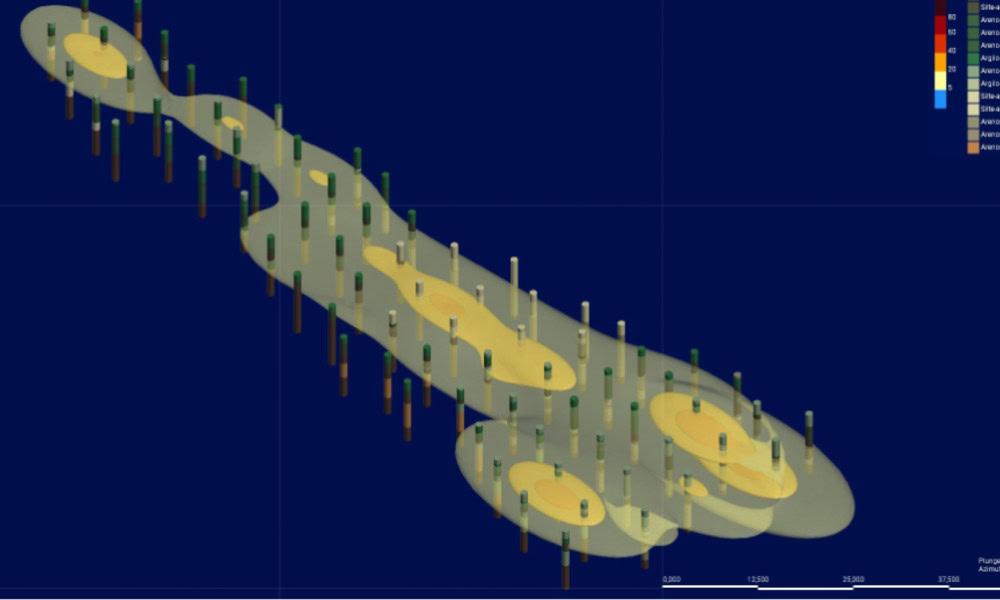
To reduce the risk of community exposure to petroleum hydrocarbons, this project aimed to remediate contaminated soil and groundwater in a rural area within São Paulo. Geoambiente was engaged to perform high-resolution 3D modeling and technical-operational design of an advanced chemical remediation system. The project required integrating multisourced voluminous data into a single, interpretable model. Conventional 2D interpolation methods resulted in simplified models that were incapable of accurately representing the site’s hydrogeology.
Geoambiente selected Leapfrog and GeoStudio for precise modeling of the contaminant plumes, achieving an 85% reduction in contaminant mass. Working in an integrated geotechnical platform centralized modeling to reduce multidiscipline data integration time by 60%, saving 2,100 technical hours to deliver the project 45 days ahead of schedule. Through accurate modeling and analysis, Geoambiente reduced the reagent volume needed for effective decontamination by 70%, saving USD 1.4 million in costs and avoiding associated reagent logistics equivalent to reducing 18 metric tons of carbon emissions.